Introduction
This section is non-normative.
What is Valueflows?
Valueflows is a vocabulary (ontology) that is intended to model and document economic activity, focused on the distributed economic networks of the "next economy", but also supporting conventional businesses and supply chains.
On a more technical level, its purpose is to facilitate interoperability among many different software projects. Although the Valueflows core model has also been used to design economic software applications, Valueflows itself is not a software application.
What do we mean, “economic network”?
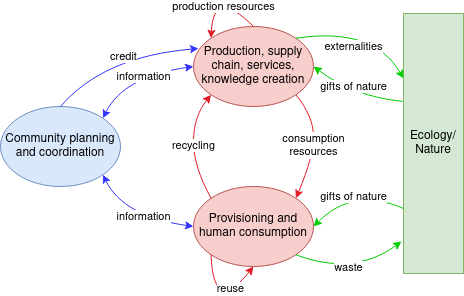
An economic network consists of independent economic agents (individual people or organizations, also expanded to include ecological agents) collaborating to produce and distribute goods and services to meet human and ecological needs. For example, food, clothing, housing, education, health care. healthy soil, etc.
If the agents in such a network want to work together, they will need to coordinate their activities. Because they are independent, they can't rely on their non-existent bosses to tell them what to do, so they will need to coordinate among themselves. The Valueflows vocabulary is designed to help them do that. We want to help enable collaboration and coordination between different people in different organizations using different software on different platforms using different human and programming languages.
What do we mean, "next economy"?
We want to support experiments towards:
- cooperation rather than competition;
- open, shared, common knowledge instead of jealously-guarded “intellectual property”;
- sustainable production instead of getting away with as much plunder as possible;
- “equitable distribution of value” vs exploitation for profit;
- respecting nature and our environment.
Non-business-as-usual experiments in organizational forms and economic relationships might call themselves a solidarity economy, cooperative, collaborative economy, small business ecosystem, P2P network, commons based peer production, contribution economy, and many other names. They can be as varied as the people and groups who create them want. To make these transitions as seamless as possible, we also support traditional business organizations and relationships.
What makes Valueflows actually different?
The Valueflows model is designed to support:
- coordination of economic activity both inside and between organizations, an enterprise is not assumed;
- reciprocity with or without money, money is not assumed;
- ecological agents as part of the network; "externalities" as resources that can be documented and internalized.
Example uses for Valueflows
Here's a (big but not all-inclusive) list of possible applications that can be built using the Valueflows model. It's a big list for a relatively simple model. This is because the model, thanks to the many shoulders it stands upon, starting with REA, can be used for almost any economic application.
Production and creation:
- manufacturing and assembly,
- distributed manufacturing,
- supply chains and economic networks,
- fablabs and open hardware design,
- inventory,
- services,
- organizational and administrative projects,
- simple todo's,
- CSA and Solawi,
- transportation,
- track and trace of resources.
Exchange:
- marketplace and e-commerce,
- point-of-sale retail,
- offers and needs publication and matching,
- mutual credit and timebanks,
- supply network purchasing,
- alternative currencies,
- barter and gift economies,
- buying clubs and consumer cooperatives,
- reward distribution based on contributions,
- direct distribution of resources.
Financing:
- savings pools,
- mutual credit financing.
Analysis and planning:
- operational planning,
- supply chain and network planning,
- community/regional planning (future release),
- gaps and opportunities analysis at any level (future release),
- standard accounting,
- climate accounting.
Economic ecosystems
We think these kinds of applications can also be building blocks to create whole economic ecosystems. Valueflows-based protocols could facilite that, as economic resource data flows from one application to another, from internal to local to bioregional to global.